
Carteret County Sex Offender Checks
The first public channel is the North Carolina Sex Offender and Public Protection Registry. Choose Carteret in the county field for a county view, use an address search for nearby entries, or search by a known name or Sex Registration Number. The SBI database covers people who must register under North Carolina law. It is not a general criminal-history search, and a blank result cannot establish that a person has no criminal record.
Four other access routes add context. The free Carteret Sheriff NC app offers a mobile sex-offender search. The Carteret County Sheriff's Office handles local registration, update, and suspected noncompliance questions. Official email alerts can track qualifying registry changes around an address. The U.S. Department of Justice's NSOPW search adds participating jurisdictions outside North Carolina. For urgent danger, call 911. Direct non-emergency compliance concerns to the Sheriff instead of confronting anyone.
Carteret Registry Counts Need Dates
As reviewed on August 1, 2026, the SBI statistics page displayed 122 Carteret registrants. That is a changing administrative count, not a crime rate or a forecast of risk. The SBI warns that entry, processing, and system delays make county totals approximate. A person may also work or study in the county under statutory rules without fitting a reader's idea of a full-time resident. Use the live registry for the current view.
The SBI county statistics page shows how the official total is presented.
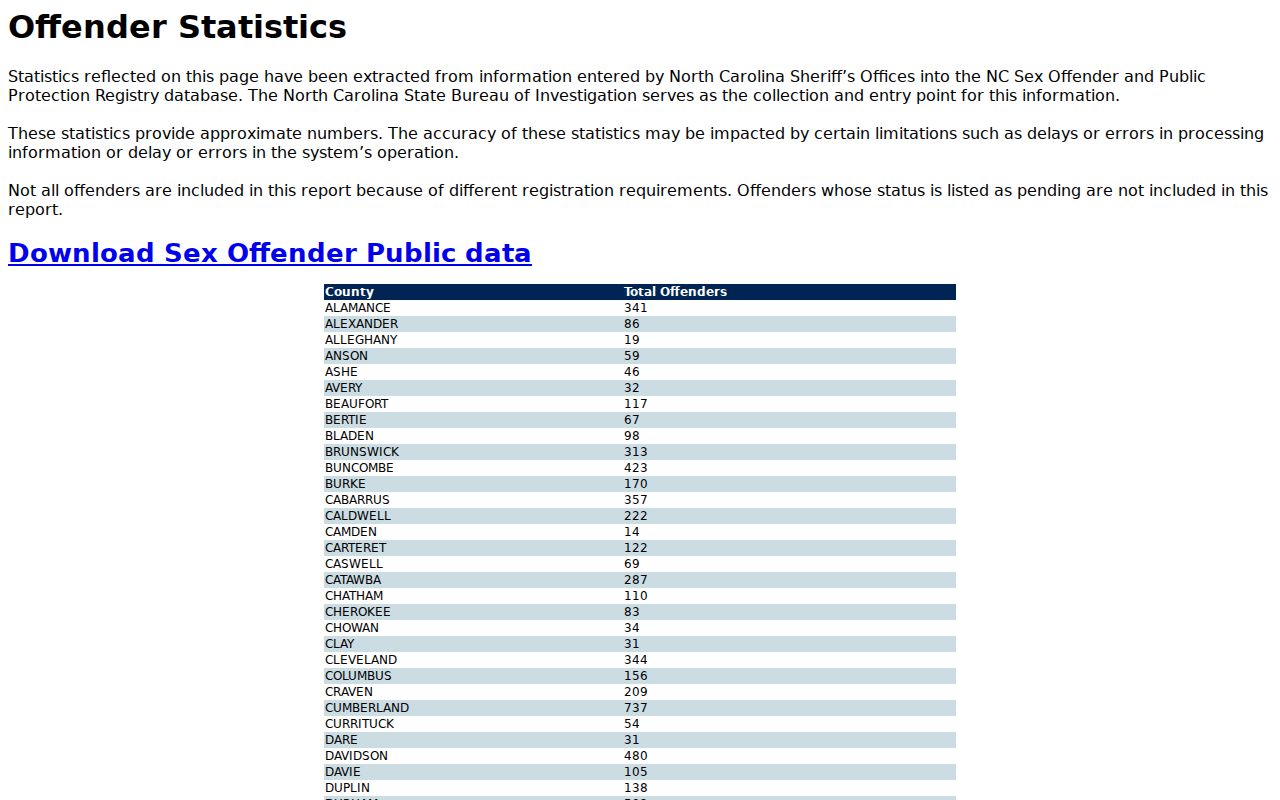
This screen is useful for statewide context, but its Carteret count still needs a date and the SBI delay warning.
North Carolina Sex Offender and Public Protection Registry Searches
The SBI has maintained North Carolina's registry program since January 1996. Its public portal offers several distinct search paths. Pick the one that matches what is known, then broaden carefully. Similar names and changing addresses can produce false matches if a user skips the photograph, physical description, registration number, and conviction details.
- Open the official SBI registry and read its use and accuracy notices.
- Choose an address, name, county, coordinates, or registration-number search.
- Enter Carteret County or the best available identifier, then review the result list.
- Open the full profile and compare identifiers, status, offense, and verification details.
| Field or Mode | Type | Required | Best Use |
|---|---|---|---|
| Nearby an address | Address/geographic | Valid address | Find entries near a location through the proximity interface |
| Offender name | Text | For name search | Start with a known name, then check all identifiers |
| City or ZIP | Text/select | No | Narrow a name or location search |
| County | Select | No | Choose Carteret for the county list |
| Latitude/longitude | Numeric/geographic | For coordinate search | Search around exact coordinates |
| Sex Registration Number | Text | For direct search | Find a known registration record |
| Email alerts | Email/address criteria | Signup fields | Receive qualifying location-based notices |
The official SBI search interface makes these routes available from one starting point.
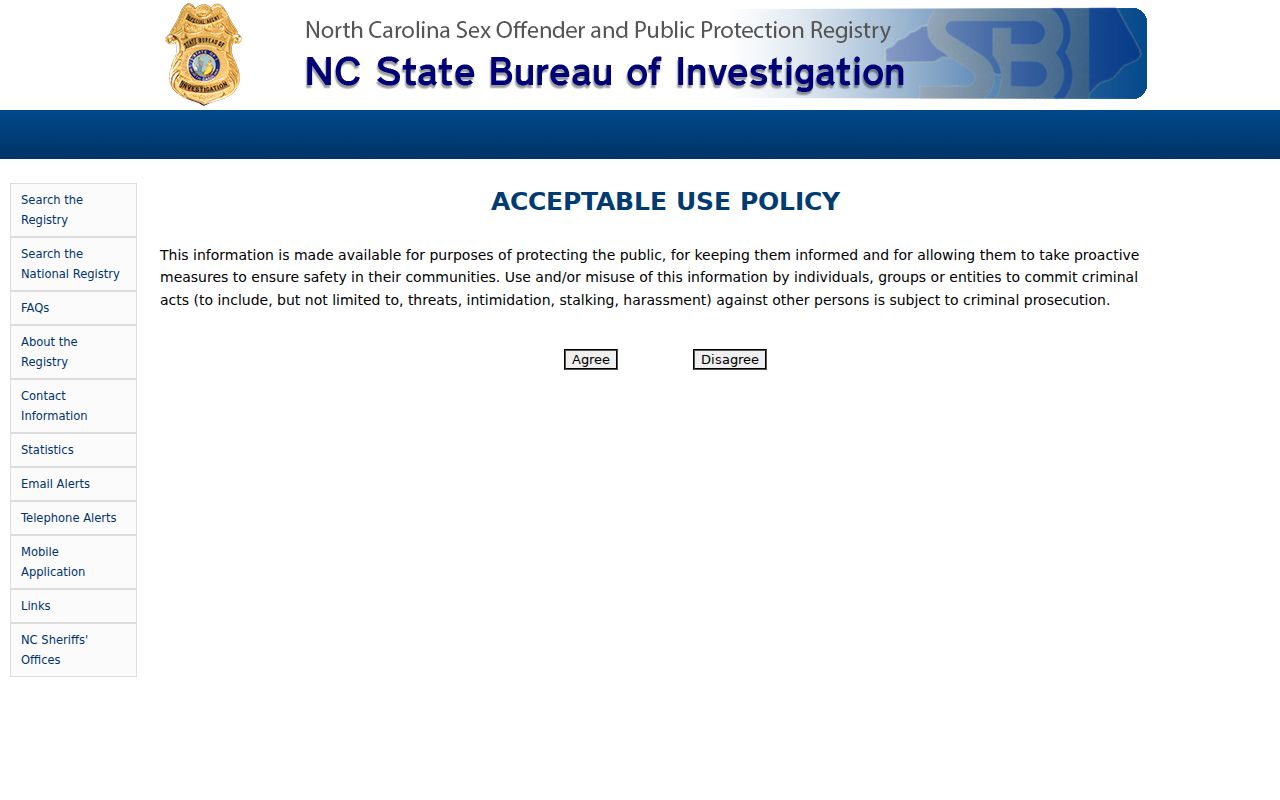
The search controls help separate a county list from a targeted name, address, coordinate, or registration-number query.
Carteret Offender Alerts and Mobile Search
The official Carteret Sheriff NC app page describes a local offender search beside inmate lookup, Most Wanted, alerts, news, and tip submission. The Sheriff advertises it as a free app developed through TheSheriffApp.com/OCV. It is a practical mobile route when the state website is awkward on a small screen, but it does not replace the SBI profile or turn Most Wanted into a full warrant list.
Email registry alerts serve a different purpose. They can notify a user about covered changes tied to saved location criteria. VINELink focuses on custody-status notifications, so it should not be treated as a copy of the registry. Use each tool for its stated role. When information conflicts, note the profile identifiers and call the Sheriff's main number for the local registration unit.
Registry Profiles: What They Show
A public profile provides identity, offense, address, and registration facts permitted by law. Exact visibility varies by record and category. A profile may contain aliases and vehicles for one person but not another. Juvenile registry material is not published on the Internet. No profile should be read as a live finding of guilt beyond the listed conviction or as an assessment of current dangerousness.
| Name and Aliases | Published identity names connected with the registration record |
|---|---|
| Photo and Description | Photograph, physical traits, and identifying marks when collected and public |
| Address and County | Registered location information and Carteret county association |
| Offense and Conviction | Reportable offense, statute, jurisdiction, and conviction details shown |
| Category and Number | Registration category, Sex Registration Number, and displayed status |
| Verification Details | Verification information and other registration facts available on the profile |
| Vehicles and Marks | Vehicle details, marks, or other identifiers when lawfully collected and displayed |
The listed address is part of a reporting system. If it looks stale, do not visit it or contact a resident. Save the registration number and the precise concern, refresh the official record, and report a possible failure to update through the Carteret County Sheriff's Office.
Beyond a Carteret Offender Search
Use NSOPW when the relevant person or address may cross state, tribal, territorial, or District of Columbia lines. It searches participating public registries from a national starting point. A national no-result is still not a certified background check. Coverage, matching rules, field labels, and update timing remain tied to each contributing jurisdiction.
The National Sex Offender Public Website supplies that cross-jurisdiction search layer.
For a move into or out of Carteret County, compare the national result with the source jurisdiction's full profile and North Carolina's record.
Registration Levels and Duties in North Carolina
North Carolina does not present its public system as a simple Tier I, II, and III chart. Part 2 and Part 3 categories, the conviction, and judicial findings control the duty. A general Part 2 registrant has a baseline period of at least 30 years after initial county registration. After ten years, an eligible person may petition Superior Court under G.S. 14-208.12A. The passage of ten years does not end registration by itself.
| State Category | Duration | Verification Concept |
|---|---|---|
| General Part 2 registrant | At least 30 years from initial county registration | Statutory verification applies; eligible termination requires a court petition after the minimum period |
| Recidivist, aggravated offense, sexually violent predator, and other Part 3 categories | Lifetime under governing provisions | More frequent verification applies |
| Nonresident worker or student | While statutory presence, work, or student duties apply | Registers through the sheriff under the applicable county rules |
G.S. 14-208.7 sets short initial registration windows for qualifying residents and new arrivals. G.S. 14-208.9 also requires prompt reporting of address and other covered changes. Readers should check the current statute and the Sheriff's instructions, since a profile label alone cannot explain every duty.
A qualifying new North Carolina resident generally must register within three business days of establishing residence or after fifteen days of presence, whichever comes first. A current resident generally registers within three business days after release or arrival in a county, or at once after a qualifying conviction that does not include prison. Work and student ties can trigger duties for a person who lives elsewhere. These deadlines explain why the Carteret Sheriff, rather than a broad online category chart, is the right office for instructions tied to a real move or status change.
Carteret Sheriff Registration Route
Local registration routes through the Carteret County Sheriff's Office at 304 Craven Street, Beaufort, NC 28516. Call (252) 728-8400 for the responsible registration unit and current appointment instructions before going. The sheriff registers and verifies local registrants, while the SBI maintains the statewide public database. That split explains why a local report and an online update may not appear at the same moment.
The SBI registry program overview describes the public program's history and scope.
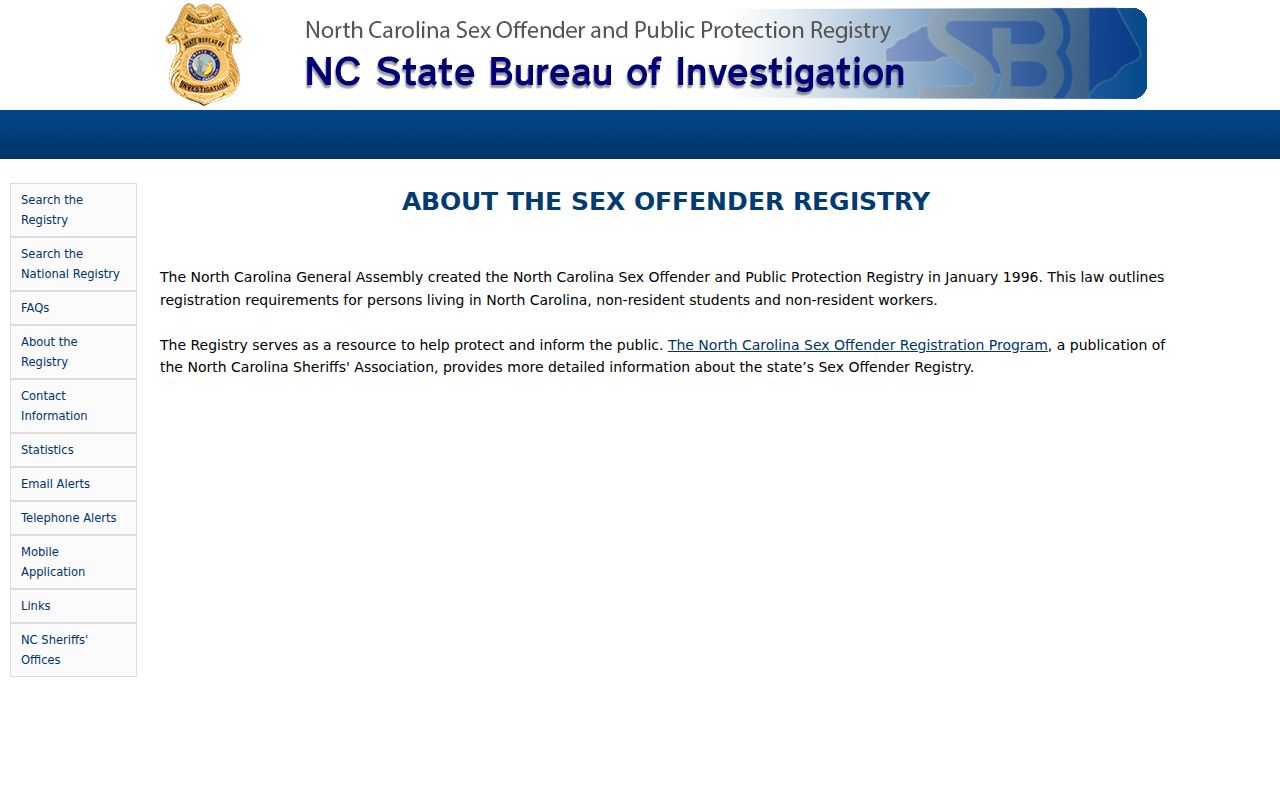
The program overview confirms that the public site concerns registered offenders, while Carteret's sheriff remains the key local compliance contact.
Processing time can separate a report made at the sheriff's office from the next public display. A person who sees an apparent error should preserve the registration number, the field in question, and the time of the search. Give those facts to the responsible registration unit. That approach lets the custodian check its source record without putting a registrant, a current resident, or a neighbor at risk through direct contact.
Carteret Registry Rules Without Myths
Do not reduce North Carolina law to a blanket countywide radius rule. G.S. 14-208.18 places specific premises restrictions on covered registrants, and the exact rule depends on the statute's terms. Likewise, residence, work, student, and presence duties can each matter. The safe course is to read the current Article 27A text and ask the appropriate official office about a concrete compliance question.
A registry entry is also not a complete Carteret County criminal history. Court files show filed charges, disposition, and sentence. SBI's public registry shows registration data for people subject to Article 27A. Those systems answer different questions. For the court outcome behind a listed conviction, use the Carteret County court case lookup and verify the source file with the clerk.
Using Registry Information Lawfully
Registry data supports informed safety choices and community awareness. Compare identifiers, keep children and household members focused on practical safety plans, and use official alerts when useful. Report suspected noncompliance to the Carteret County Sheriff's Office. Call 911 for an immediate threat. Do not contact, follow, expose, or threaten a registrant or anyone at a listed address.
Misuse is prohibited: North Carolina's Article 27A registry framework forbids misuse and harassment-related conduct. Never threaten, intimidate, harass, discriminate against, or take vigilante action against a registrant or household.
Errors and lags can occur. If a Carteret profile appears outdated, record the registration number and what seems wrong, then reach the Sheriff's Office through its official records contact channel. Public safety comes from accurate reporting and lawful action, not assumptions drawn from a map pin.