
Criminal Court Cases in Carteret County
Carteret County criminal cases run through the state courts at the Carteret County Courthouse. District Court hears misdemeanors and infractions. It also handles first appearances and other preliminary felony work. Superior Court hears felony cases after indictment and tries misdemeanor appeals anew. Both divisions are part of District 4, which also covers Craven and Pamlico counties. A person using a statewide tool should therefore filter the location to Carteret County instead of assuming that a similar name or case number belongs here.
The Clerk of Superior Court keeps the case files for both divisions. Those files are the source for charging papers, motions, calendar events, pleas, judgments, and sentences. The county has no separate city municipal court. A charge that began with Morehead City, Beaufort, or Newport police enters the same state District or Superior Court structure. That makes the clerk, not a town court office, the right custodian for the filed Carteret County court record.
Carteret County Court Case Divisions
The court division tells a reader which part of the Carteret County case trail matters. A misdemeanor normally stays in District Court unless appealed. A felony may first appear on a District Court calendar for an initial hearing, then move to Superior Court after the prosecutor pursues an indictment. The shift does not create a city or county court outside the North Carolina Judicial Branch. It marks a new stage within the unified state system.
| Court or office | Carteret County case role | Public contact |
|---|---|---|
| District Court | Misdemeanors, infractions, and preliminary felony stages | 300 Courthouse Square, Beaufort; (252) 504-4400 |
| Superior Court | Felonies, indictments, trials, and misdemeanor appeals | 300 Courthouse Square, Beaufort; (252) 504-4400 |
| Clerk of Superior Court | Files, public terminals, copies, and certified searches | Weekdays, 8:30 a.m. to 5:00 p.m. |
The official Carteret County court hub brings together calendars, forms, location notices, and eCourts updates. Its county view helps keep a District 4 search tied to the right courthouse.
The same Judicial Branch source supplies a clear county landing view for Carteret criminal cases. See the source shown in the Carteret court hub image.
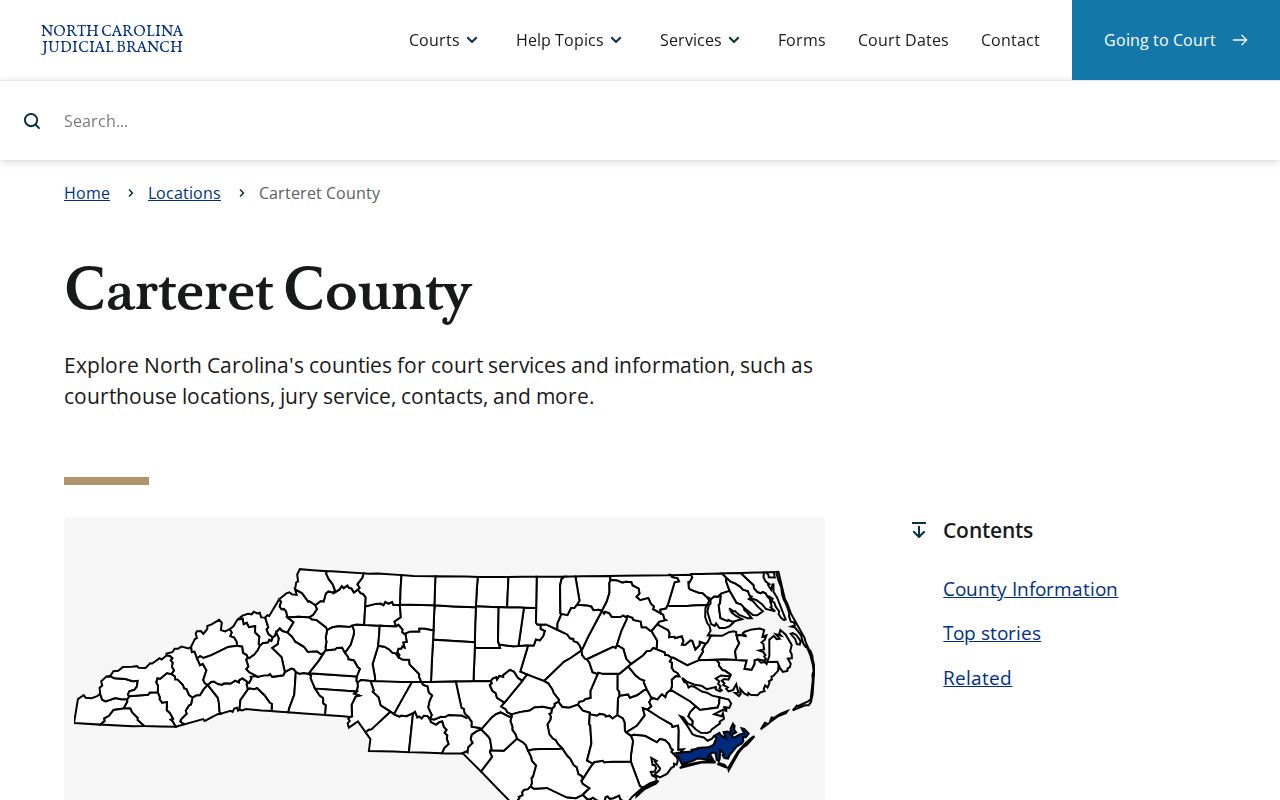
This view is a routing point, while the clerk's file remains the record to inspect when a docket entry needs proof or context.
Carteret County Case Record Searches
Start with the channel that matches the question. North Carolina eCourts Portal is useful for a known Carteret County case. Court Dates answers when an appearance is set. A courthouse terminal can search public court data across one county or statewide at no charge. The clerk counter supplies documents that are not available as remote images. A certified single-county name search is a separate product and does not turn Portal into an official background-check service.
- Open the North Carolina eCourts Portal and search by a party name or case number.
- Use the location, status, case type, or filing-date filters and select Carteret County where the live interface allows it.
- Check Court Dates when the goal is a hearing date, but do not read a calendar entry as the final outcome.
- Use a courthouse public terminal or ask the clerk to retrieve the file when an image or older document is absent online.
- Request a plain copy, certified document, or AOC-CR-314 certified Carteret search according to the type of proof needed.
| Tool or field | Type | Required | Use |
|---|---|---|---|
| Smart Search criteria | Text | Yes | Party name or case number |
| Advanced filters | Expandable | No | Court, location, type, status, or filing date |
| Court Dates name | Text | Conditional | Find a scheduled defendant appearance |
| Citation number | Text | Conditional | Alternative court-date key |
| County | Dropdown | Recommended | Choose Carteret to narrow results |
The North Carolina Court Dates search is the official schedule channel. The search screen shown below makes the county filter important for Carteret County criminal cases.
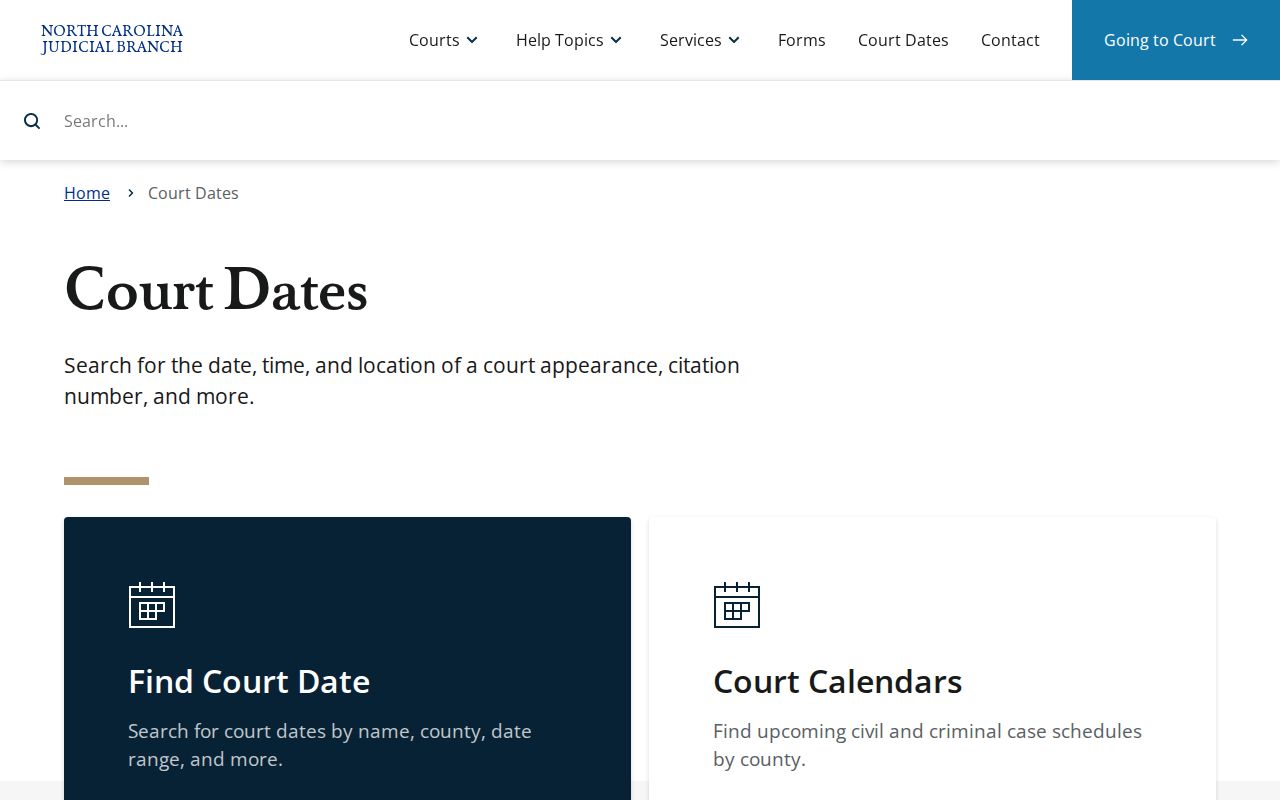
A result confirms a listed setting, not whether the charge was dismissed, tried, or resolved by plea.
Carteret County eCourts Case Search
Carteret County joined eCourts on February 3, 2025, as part of the Track 7 coastal rollout. That milestone explains why older instructions may point only to legacy courthouse systems. Portal now offers statewide case information, yet it did not replace the clerk's counter, public terminals, or paper and electronic case files. Document images can vary by case and access level. A missing image is not proof that no document exists.
The Judicial Branch also draws a firm line between viewing case information and ordering a certified criminal record search. Anyone may ask the Carteret County Clerk for a certified name search on form AOC-CR-314. That search costs $25 and covers Carteret County court records only. A free public-terminal query can be countywide or statewide, but it is non-certified. The official criminal record check instructions explain both routes.
The official comparison of certified and self-service options is visible in the source image. Review the Judicial Branch source for Carteret court checks.
This distinction prevents a free Portal result from being mistaken for a clerk-certified Carteret County court search.
What a Criminal Case File Contains
A Carteret County criminal case file is built around litigation, not jail custody. It may identify the filed charge, court division, parties, attorneys, events, process, hearings, outcome, and sentence. Some public values can change as a charge is amended or a court enters a later order. The case number is the best key when asking the clerk for a specific paper or electronic document.
| Case number and court | Identifies Carteret County, the division, file, type, status, and filing date. |
|---|---|
| Charging document | Shows the complaint, process, information, or indictment the State filed. |
| Docket entries | List continuances, motions, hearings, pleas, verdicts, orders, and compliance events. |
| Hearing dates | Give the session, courtroom, date, and hearing type when entered. |
| Disposition and judgment | Record outcomes such as guilty, not guilty, dismissed, or voluntarily dismissed. |
| Sentence and conditions | May show confinement, probation, fines, costs, restitution, or other public terms. |
Sensitive identifiers, protected victim information, juvenile matters, and sealed or expunged records do not belong in the public view. A file can also lack a remote image even when its docket entry is public.
Carteret County Court Docket Terms
Short docket labels can change the meaning of a Carteret County case result. A calendar setting says that an event was scheduled. It is not a disposition. “Pending” means the case or charge remains unresolved. “Dismissed” means there was no conviction on that charge, but it does not automatically remove the historical court or arrest record. The judgment and sentence should be read together when the result is guilty.
- Disposition
- The court's recorded outcome for a charge or case.
- Indictment
- A grand jury's formal felony accusation, often called a true bill.
- Arraignment
- The stage when the defendant is formally addressed about the charge and plea.
- Voluntary dismissal
- The prosecutor ends a charge without a conviction, subject to procedure.
- Order for arrest
- North Carolina process that can issue after a failure to appear or comply.
Charge wording can also differ from the booking entry because the prosecutor may amend, decline, or replace the intake allegation. The filed Carteret County charge is found in the court record, while the earlier booking remains a separate record.
Criminal Case Stages in Carteret County
A Carteret County criminal case may start with an arrest or judicial process. A magistrate handles the initial appearance and release conditions within the magistrate's authority. Misdemeanors proceed in District Court. A felony receives preliminary District Court handling before indictment and Superior Court proceedings. The prosecutor may change the charge as the evidence and legal review develop.
Case flow: Charges Filed → Arraignment → Pretrial → Plea or Trial → Disposition → Sentencing
Appeal and compliance events can follow sentencing. A misdemeanor appeal goes to Superior Court for trial anew, while other appeals follow the rules for the court and order involved. Each stage can add a new docket entry or document. That is why one Portal snapshot may not tell the full Carteret County case story.
Carteret County Certified Case Checks
A certified Carteret County name search is ordered from the Clerk of Superior Court with the current AOC-CR-314 form and a $25 fee. Mail requests accept a money order or certified check, not a personal check. In-person payment may be made by credit card, cash, money order, or certified check. The result is limited to Carteret court records. It is not a fingerprint-based SBI record and does not search cases filed only in another county.
Carteret Clerk of Superior Court
300 Courthouse Square
Beaufort, NC 28516
(252) 504-4400
Monday through Friday, 8:30 a.m. to 5:00 p.m.
For self-service research, courthouse terminals permit free non-certified searches by defendant name, case number, or victim or witness name. Results can be viewed or emailed; a print cost may apply. Calling before a trip is wise for older files because the research found no published Carteret archive cutoff or research fee.
Missing Carteret County Case Images
When a Carteret County docket lists an event but no document image appears, keep the case number and contact the clerk. Ask to inspect the case file, then name the item needed, such as the charging document, judgment, or sentencing order. The clerk can explain whether the public document is available as a plain or certified copy. Sealed, expunged, juvenile, or otherwise restricted material will not be released merely because a docket search hints that an event occurred.
Expunction adds another layer. An eligible Carteret matter must follow the statute-specific Judicial Branch petition process in the county where it was charged or decided. A dismissal alone does not erase the file. The official North Carolina expunction page supplies current forms and instructions.
The source image below reflects that official court process. View the Judicial Branch expunction source for Carteret cases.
An order must be processed through the named court and agencies before an eligible Carteret County record stops appearing in their systems.
Access Rules for Case Records
North Carolina law generally permits public inspection and copies of court records under G.S. 7A-109, subject to other laws and court rules. That right does not expose every item. Juvenile files, expunged or sealed matters, protected victim data, sensitive identifiers, and other confidential records remain restricted. Document access may also differ from the public docket fields shown through eCourts.
Requests should be narrow and tied to a file number when possible. For an older record, ask what index or archive is available before travel. If the question concerns a Sheriff's arrest report rather than the court filing, use the creating law-enforcement agency. The broader Carteret County arrest search explains that separate custody and report trail.
Note: A court calendar shows a planned event, while the disposition and judgment show what the Carteret County court actually decided.