
Beaufort Criminal History Checks
Begin with the record’s creator. Beaufort Police is the source for a municipal incident or arrest report. Carteret Inmate Inquiry is the source for current county custody. North Carolina eCourts Portal and the Carteret Clerk serve filed court matters. SBI Right to Review is reserved for a fingerprint-based review of one’s own statewide repository history. These routes overlap around the same event but do not produce the same file.
A focused Beaufort search follows five steps:
- Request a Beaufort Police report directly from the Town or Police official channel, using the incident number, date, and location.
- State whether inspection or a copy is sought, and do not send a town request to Carteret County’s administrative form.
- Check Carteret Inmate Inquiry for a recent jail booking and contact the detention center if current status is unclear.
- Search eCourts Portal and Court Dates with Carteret selected, then ask the Clerk for documents or certification.
- Use SBI Right to Review for one’s own fingerprint-supported North Carolina record, not as a public person search.
Three Beaufort Criminal Record Counters
Beaufort’s local record geography is unusually compact. The Carteret courthouse is at 300 Courthouse Square. The Sheriff and detention center are at 304 Craven Street. Beaufort Police is a town agency in the same community. Nearness does not merge their authority. A street incident handled by town police stays a Beaufort Police report even if the arrested person is booked a short distance away.
| Custodian | Record | Use It For |
|---|---|---|
| Beaufort Police | Town incident or arrest report | Public facts about the municipal police event |
| Carteret Sheriff and jail | Sheriff report or county booking | Sheriff-created incidents and current custody |
| Carteret Clerk | District or Superior Court file | Filed charge, dates, disposition, judgment, and copies |
Ask which agency created the document before choosing a counter. This one question prevents most Beaufort routing errors.
Records at the Beaufort Police Department
Beaufort Police creates municipal incident and arrest records. Request those records through the official Town of Beaufort channel or its Police Department page. Give a useful event description, incident number when known, date, and location. The research did not locate an indexed Beaufort police request form, current report fee, or counter schedule. Do not guess at any of them, and confirm the current method before visiting.
The town may release the public portion of a report while withholding the investigative file or protected details. A request for all evidence, officer notes, and witness material can reach legal limits that do not apply to listed incident facts. If the arrest was made by the Sheriff or a state officer within Beaufort, request the creating agency’s report instead. The city boundary does not automatically make Beaufort Police the custodian.
Beaufort County Seat Custodian Trap
Beaufort is Carteret County’s seat and justice-center town. That label can cause a false assumption that one county office holds every local record. The Town of Beaufort, Carteret County administration, Sheriff, Clerk, and statewide Judicial Branch remain separate public bodies. Each answers only for records it made or received under law.
A municipal request goes to Beaufort. A county administrative record goes to the county custodian. A Sheriff report goes to Sheriff Records. A court filing goes to the Clerk. Carteret County’s own request form warns that municipal, court, and law-enforcement requests must be sent to the proper agency. When a request is misdirected, rerouting costs time and may produce a response that no responsive records exist even though another office has the file.
Note: A Beaufort address identifies location, not the government body that owns the requested criminal record.
Booking and Arrest Records in Beaufort
A Beaufort Police arrest can produce a city report and a Carteret County booking. The county detention center at 304 Craven Street is the county’s only jail identified in the research. Its public inquiry may list booking date, custody status, arresting agency, charges received, bond information, and release data, subject to what the live vendor displays.
Use the Carteret Inmate Inquiry gateway for current custody. Its strong disclaimer warns that intake information may be supplied before fingerprint or criminal-history verification is complete. A listed booking allegation is not a conviction. A missing name can reflect release, transfer, spelling, delay, or lack of a jail booking. Call (252) 504-4832 for an inquiry discrepancy. Request the police report from Beaufort Police and check the court file separately for the State’s filed charge and result.
When Beaufort Records Stay Investigative
North Carolina G.S. 132-1.4 generally excludes criminal investigative and intelligence files from the ordinary definition of public records. The same law makes specified incident and arrest facts public. Beaufort may therefore disclose the time, date, location, nature, alleged violation, and other listed public facts while withholding evidence, investigative strategy, protected identities, or sensitive material.
Narrow the request to the report and public event facts. If a field is redacted, ask the town to identify the legal basis rather than assuming the entire event is hidden. Caller, victim, witness, juvenile, medical, financial, and identity information may receive added protection. Body-camera recordings also follow a distinct North Carolina disclosure process and should not be requested as though they were an ordinary paper police report. A careful Beaufort request states the format sought but allows the custodian to apply lawful redactions.
The Beaufort Municipal Court File
Beaufort has no separate municipal court. North Carolina’s unified state system handles city-originating criminal, traffic, and ordinance matters through Carteret District Court. District Court also manages early felony stages. Superior Court hears felonies after the required path and misdemeanor appeals for a new trial. Both divisions use the Carteret County court system, and the Clerk of Superior Court is custodian for their files.
| Court Name | No Beaufort municipal court; Carteret District Court handles local traffic, ordinance, misdemeanor, and preliminary felony matters. |
|---|---|
| Felony Court | Carteret Superior Court hears felony trials after indictment and related procedure. |
| Lookup Channels | eCourts Portal, Court Dates, courthouse public terminal, and Clerk file. |
| File Contents | Case number, charge, events, settings, plea, disposition, judgment, sentence, and accessible documents. |
| Certified Search | AOC-CR-314 through the Clerk for $25; it covers Carteret County court records only. |
The municipal-court label is a routing prompt, not a real Beaufort docket. Always choose Carteret when filtering the state tools.
Beaufort Courthouse Record Terminal
The courthouse public terminal provides a free route when an online case entry is incomplete or hard to identify. Official instructions permit searches by defendant name, case number, or victim and witness name. A user may search Carteret records or look statewide, view results, and email non-certified information. Printing can carry an applicable charge.
Portal may help identify the case number, division, status, parties, charges, and events, but document images are not assured. Ask the Clerk to inspect the paper or electronic file when the needed item is absent online. For a certified single-county record search, submit AOC-CR-314 and $25. Mail uses a money order or certified check, not a personal check. In-person forms of payment include credit card, cash, money order, or certified check. Those certification details belong to the court route, not Beaufort Police.
How Beaufort Records Reach the County
A Beaufort event can produce a town report, county booking, judicial process, and a fingerprint-supported repository cycle. Beaufort Police records the incident and arrest. Carteret Detention Center records county intake. The magistrate and Clerk create the court process and case file. SBI CIIS can later connect fingerprints and reported court dispositions. Changes or reporting lag can leave the layers out of sync.
Record flow: Beaufort Police › Carteret County Detention Center › Carteret District or Superior Court › North Carolina State Bureau of Investigation
Use the town report for the police event, inmate inquiry for current custody, and the court file for what the State filed and how the judge resolved it. Use SBI Right to Review only for the subject’s own statewide repository history. County-wide court detail belongs in the Carteret court case lookup, while the Beaufort route stays focused on local custody and record ownership.
Beaufort SBI Record Review
North Carolina has no general-public instant SBI name-search portal. The official repository route is a fingerprint-based Right to Review for one’s own North Carolina record. That record is identity and arrest-cycle oriented. It can include names and aliases, identifiers, fingerprints, arresting agency and date, arrest charges, and dispositions reported to SBI. It differs from a Beaufort Police report and from a Carteret court file.
The SBI Criminal Information and Identification Section explains repository processing and correction contacts. The official SBI page pictured below reinforces that a repository review is its own channel.
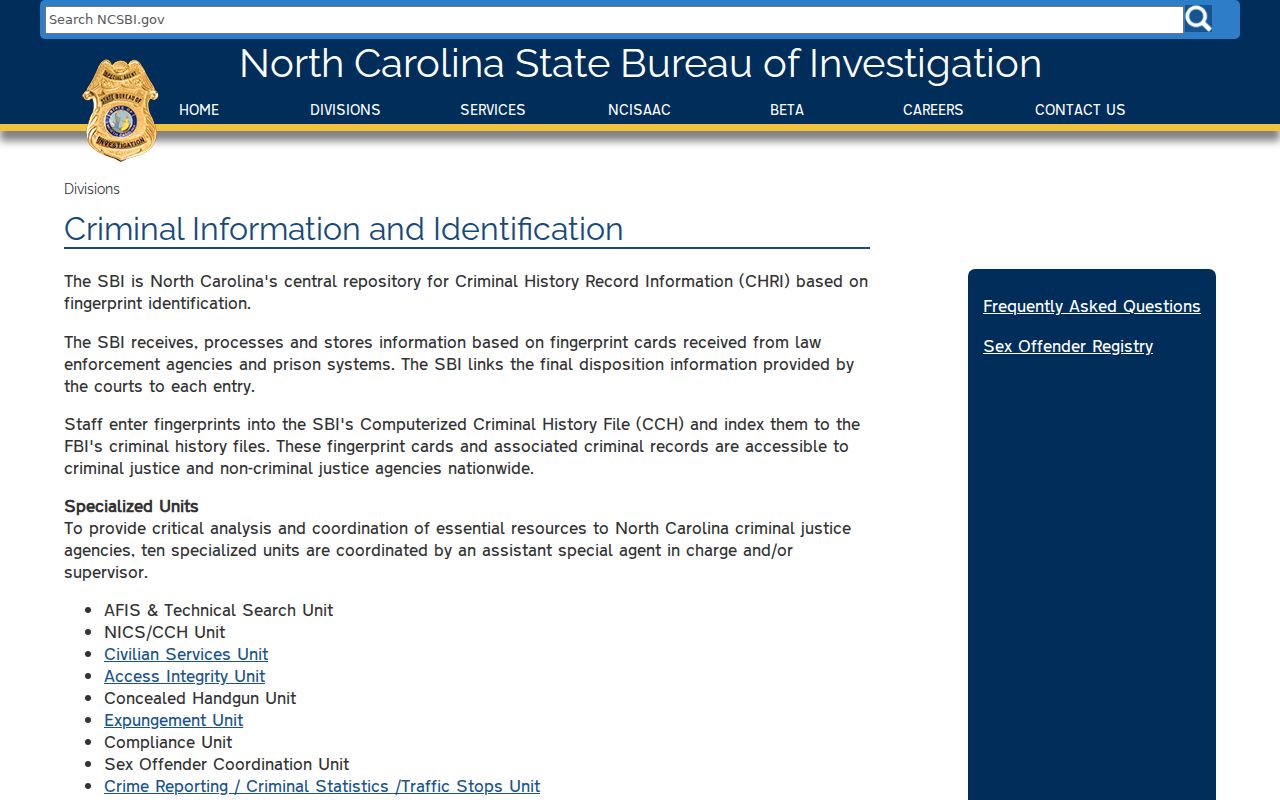
Use city and court records to diagnose a mismatch, then contact SBI when the subject’s own fingerprint history appears to lack or misstate a reported disposition.
Filter Beaufort Criminal Court Results
Carteret belongs to Judicial District 4 with Craven and Pamlico. A Beaufort search should be filtered to Carteret, since the district name alone does not identify the county of filing. In eCourts Portal, start with a party name or case number, apply Carteret and criminal filters when available, and confirm the file number, court division, filing date, and case status.
Use Court Dates for a coming appearance, not a final outcome. Calendars can change and do not show that a charge ended in conviction, dismissal, or acquittal. If an online image is missing, the Clerk file at 300 Courthouse Square is the fallback. Older records may also need staff help, and the research found no fixed archive cutoff or separate research fee. Call the courthouse at (252) 504-4400 before a trip when the file’s age or format is uncertain.
Read each Beaufort result through its full sequence. A booking label can differ from the charge a prosecutor files. A pending status means the matter remains unresolved. A dismissal means that charge ended without a conviction, but it does not promise that every linked police or booking reference has disappeared. A guilty entry must be read with the judgment and sentence. These distinctions are why the county filter and case number matter more than a name match alone. If two Beaufort results look alike, compare filing dates, offense dates, court divisions, and public attorney entries before asking the Clerk to identify the correct file.
Beaufort Record Access Rules
Public access depends on record type, not just subject matter. Chapter 132 governs town and county government records, with exceptions. G.S. 132-1.4 distinguishes public incident and arrest facts from restricted investigative material. Court records are inspected under G.S. 7A-109 and applicable court rules. SBI repository criminal-history information has its own limits and personal-review process.
Key Statutes:
North Carolina Public Records Law, Chapter 132 defines public records, calls for prompt access, and permits lawful copy or extraordinary-use charges.
G.S. 132-1.4 protects investigative files while identifying incident and arrest facts open to the public.
G.S. 7A-109 governs inspection and copies of public court records.
Be precise, accept lawful redaction, and verify a court outcome before relying on an older Beaufort allegation.