
Carteret County Criminal History Checks
Start with the event or status that needs proof. A current detention question belongs in Carteret Inmate Inquiry. Filed charges, hearing dates, pleas, dismissals, and sentences belong in North Carolina eCourts Portal, Court Dates, or the Clerk of Superior Court file. A certified Carteret name search comes from the clerk. A person reviewing their own fingerprint-linked North Carolina history follows the SBI Right to Review route. Someone looking for a state prison or supervision record uses NCDAC Public Offender Search.
Keep the full name, spelling variants, an estimated event date, and the county ready. A birth date can help distinguish similar names where the official system lawfully displays or accepts it. Compare case numbers and charge dates before treating a result as a match. Then retrieve the source document, because a result list is a pointer and not the whole Carteret County criminal record.
- Choose the jail, court, sheriff, SBI, or corrections channel that answers the exact question.
- Search the name or case number and narrow the location to Carteret County.
- Compare dates, court division, agency, and status before accepting a likely match.
- Open the court file or request the agency report that supports the online entry.
- Use the clerk or fingerprint process when a certified or identity-based result is required.
Two Carteret Record Counters Compared
Two Beaufort counters sit close together but hold different files. The Carteret County Courthouse at 300 Courthouse Square houses District and Superior Court records. Its public terminal can search by defendant name, case number, or victim or witness name. The clerk can retrieve the case file, make copies, and process a certified single-county name search. The Sheriff Records lobby at 304 Craven Street instead handles sheriff-created incident, arrest, accident, booking, and related law-enforcement material.
The official Carteret courthouse listing shows the court building and confirms its access details.
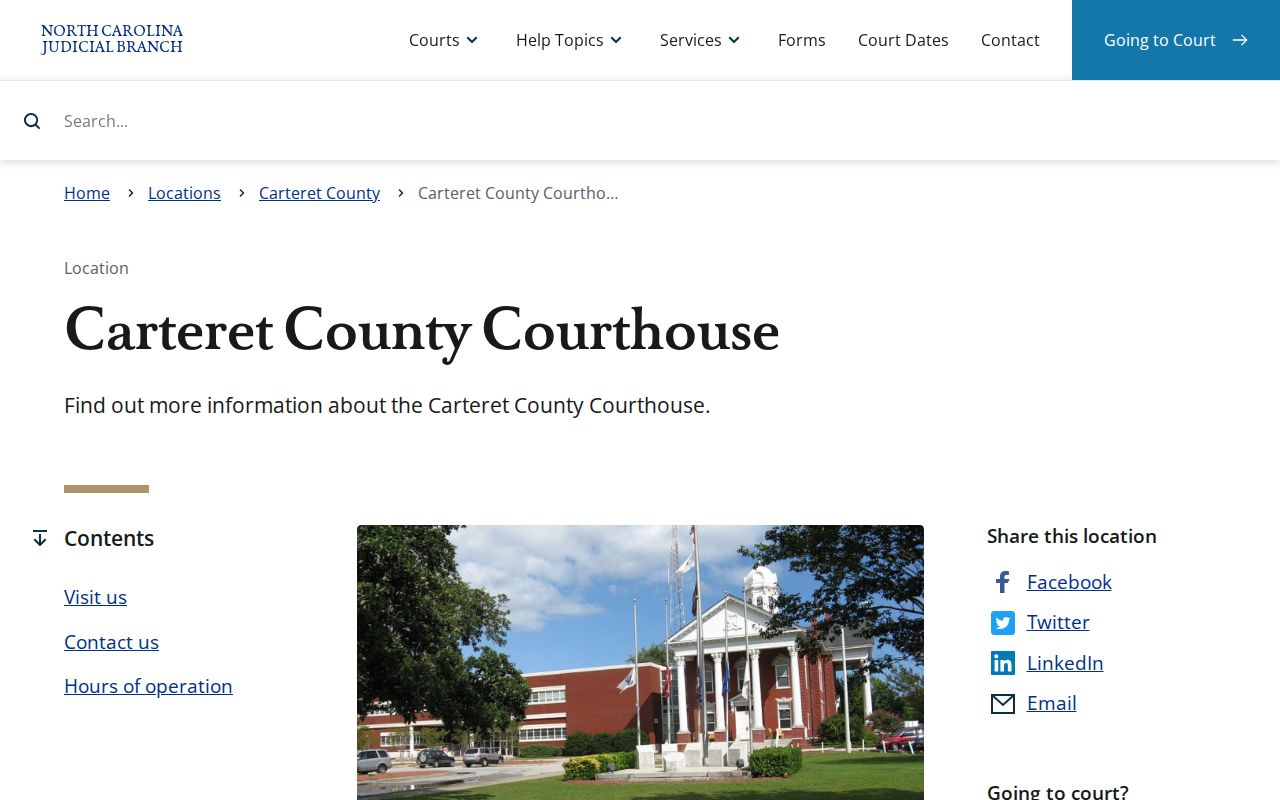
The courthouse image marks the correct destination for a filed case, not for a town police report or sheriff investigative file. Court counter hours are 8:30 a.m. to 5:00 p.m. on weekdays, and the main number is (252) 504-4400. The Sheriff and Detention Center share 304 Craven Street and use (252) 728-8400. Calling the right custodian first can prevent a request from being sent back.
| Question | Starting office | Record obtained |
|---|---|---|
| What did the court file? | Carteret Clerk | Docket, orders, disposition, sentence |
| What did the sheriff report? | Sheriff Records | Public arrest or incident facts and releasable report material |
| Is the person in local custody? | Carteret Detention Center | Current booking and custody information |
Official Background Checks in North Carolina
North Carolina provides several official products, and each has a different scope. The Carteret Clerk offers a certified county court search by name for $25 using AOC-CR-314. A courthouse terminal provides a free, non-certified search of county or statewide court data, though print charges may apply. The SBI Criminal Information and Identification Section gives a person fingerprint-based access to their own North Carolina criminal history through Right to Review. It does not offer a general public instant name portal.
The FBI Identity History Summary is also a subject-only, fingerprint-based product. It reflects data supplied to the FBI and cannot replace a Carteret court file when the goal is to confirm a local disposition. Fingerprints may be taken through a law-enforcement agency that offers public service, but Carteret County Sheriff, Morehead City Police, and Havelock Police availability, identification rules, card supply, fees, and appointments should be confirmed before arrival.
| Official product | Scope | Verified cost |
|---|---|---|
| Carteret certified search | Carteret County court records by name | $25 |
| Courthouse terminal search | County or statewide court data | Free search; prints may cost |
| SBI Right to Review | One's own fingerprint-linked North Carolina record | Current fee not verified in the source |
| FBI Identity History Summary | One's own FBI identity-history file | Verify the current federal fee |
Carteret eCourts Records Since 2025
Carteret joined North Carolina eCourts on February 3, 2025, as part of the thirteen-county Track 7 rollout. That change added the statewide Portal and electronic case tools to older counter and terminal methods. Portal helps identify a case number, court location, division, status, parties, charges, events, and dates. Document images are not guaranteed. The clerk's electronic or paper file remains the fallback, and the clerk remains the source for certification.
The Judicial Branch does not present Portal as its certified background-check product. Use it to find and follow a case, and use the clerk when an authenticated Carteret result is needed. Court Dates answers a narrower question about the next scheduled appearance. A calendar listing is not a verdict or disposition.
| Tool or field | Input | Use |
|---|---|---|
| eCourts Smart Search | Party name or case number | Find case information and events |
| Advanced filters | Location, case type, status, or filing date | Narrow results to Carteret criminal matters |
| Court Dates name search | Defendant name | Find a scheduled appearance |
| Citation and county | Citation number and Carteret | Limit a calendar search |
Note: District 4 also includes Craven and Pamlico, so confirm that a similar name belongs to a Carteret case before relying on it.
Kinds of Criminal Records
A Carteret County criminal history is assembled from records created at different times. The arresting agency writes its report. The jail creates an intake record. A judicial official issues process and sets early conditions. The prosecutor and clerk then create the court file if charges proceed. Fingerprints sent to SBI form an arrest cycle that can later receive a court disposition. These sources may disagree for a time without any one of them being fabricated.
- Arrest and incident reports: public event facts and releasable agency material, with investigative content restricted by law.
- Booking records: intake identity, charges received, bond, booking date, agency, and current local custody status.
- Court case files: filed charges, court events, pleas, rulings, disposition, costs, and sentence.
- SBI history: fingerprint-based arrest cycles and the dispositions reported back by courts.
- Custody and supervision records: county jail data for local custody and NCDAC data for prison or state supervision.
- Registry records: public information about people who have a current legal duty to register.
Warrants and orders for arrest are judicial process, not proof of a conviction. Active, sealed, juvenile, or unserved process may be unavailable online. The sheriff app's Most Wanted feature is selective and cannot certify that no process exists.
Carteret Sheriff Record Channels
The Sheriff's Professional Standards area includes the Records Division. Staff maintain archives and databases, give out incident, arrest, and accident reports, receive booking prints and offense paperwork, and maintain crime statistics. The public counter is in the Sheriff's Office lobby. Records can be reached at (252) 728-8400 extension 8801 or by fax at (252) 504-4818. The office states that routine reports are free to Carteret residents, but the research did not establish a general fee schedule for other request types.
The Carteret public-record request form is an administrative county route and explains which requests it cannot handle.
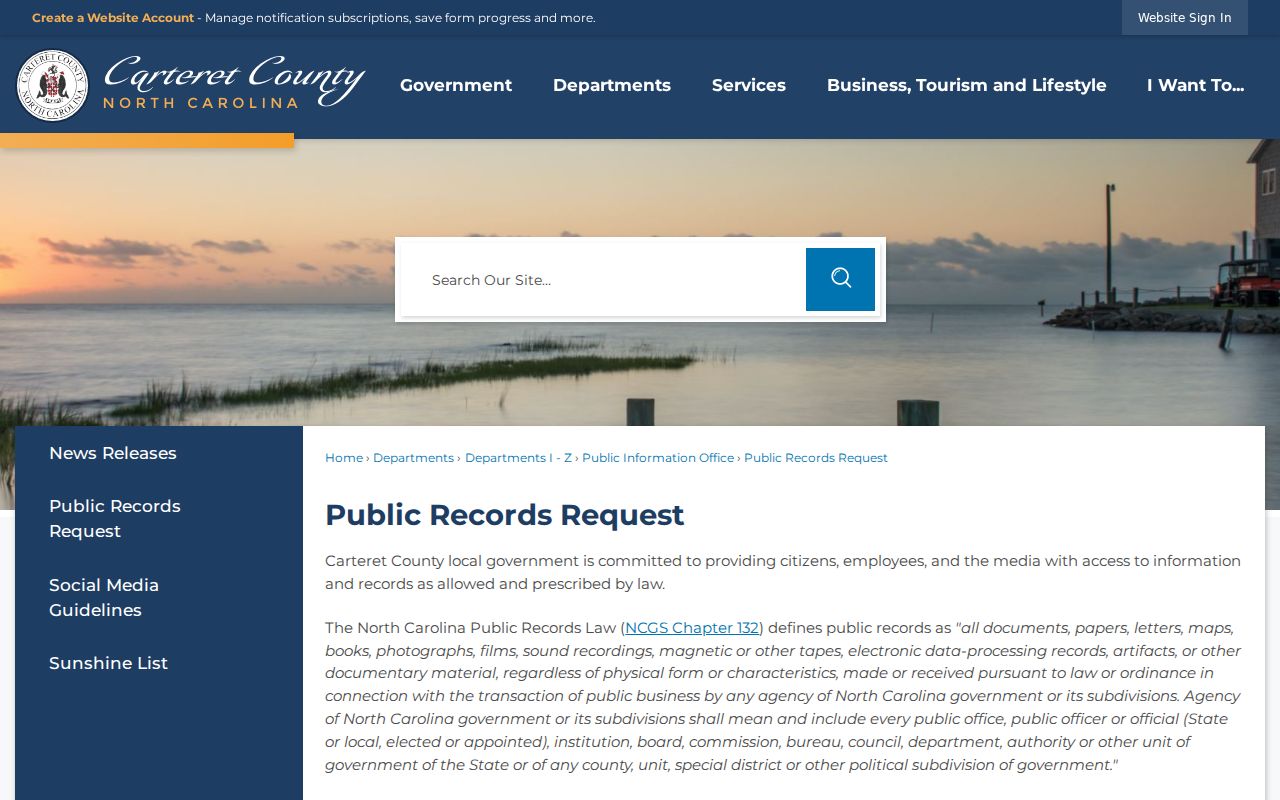
The form sends law-enforcement requests to the Sheriff or arresting agency, court files to the clerk, and municipal records to the town that created them. It asks for a description, email, copy-or-inspection choice, and preferred contact method. Electronic production is generally free when practical. Chapter 132 permits actual copy costs and an extraordinary-use service charge, but it sets no fixed number of days. Access must be provided as promptly as possible.
Sheriff Records Division
304 Craven Street
Beaufort, NC 28516
(252) 728-8400 ext. 8801
County Record Custodian
210 Turner Street
Beaufort, NC 28516
(252) 728-8450
Carteret County Criminal Records: What They Contain
The fields depend on the source. An SBI record is organized around identity, fingerprints, agencies, arrest cycles, charges, and reported outcomes. A court case is organized around litigation. It shows a case number, parties, filed allegations, dates, hearings, motions, judgment, costs, and sentence. A booking record focuses on custody, including the intake event, booking number, agency, charges received, bond, and release status.
| Name and identifiers | Names, aliases, demographic descriptors, and state or FBI identifiers where lawfully shown. |
|---|---|
| Arrest and booking | Agency, event date, booking number, intake allegations, bond, and custody status. |
| Charges and statutes | Filed offense description, statute, date, and class when recorded. |
| Disposition | Guilty, not guilty, dismissed, voluntarily dismissed, remanded, or another recorded outcome. |
| Sentence | Confinement, probation, fines, costs, restitution, and compliance events when public. |
| Restrictions | Sealed or expunged files, juvenile material, protected identities, and sensitive identifiers are withheld. |
Charge labels can change after intake. A missing disposition may reflect reporting delay or an unmatched fingerprint cycle. Compare the Carteret clerk file with a personal SBI review before seeking a correction.
Carteret Jail Records and Intake Limits
The Carteret County Detention Center is the county's only jail. Its official site reports an average daily population of 117, which is an occupancy measure rather than a count of convictions. Carteret Inmate Inquiry requires acceptance of a disclaimer. The county warns that data may include details supplied by an arrestee or arresting agency before fingerprint and criminal-history checks are complete. A booking allegation is not a court finding.
The official Detention Center profile identifies the Beaufort facility and its role.
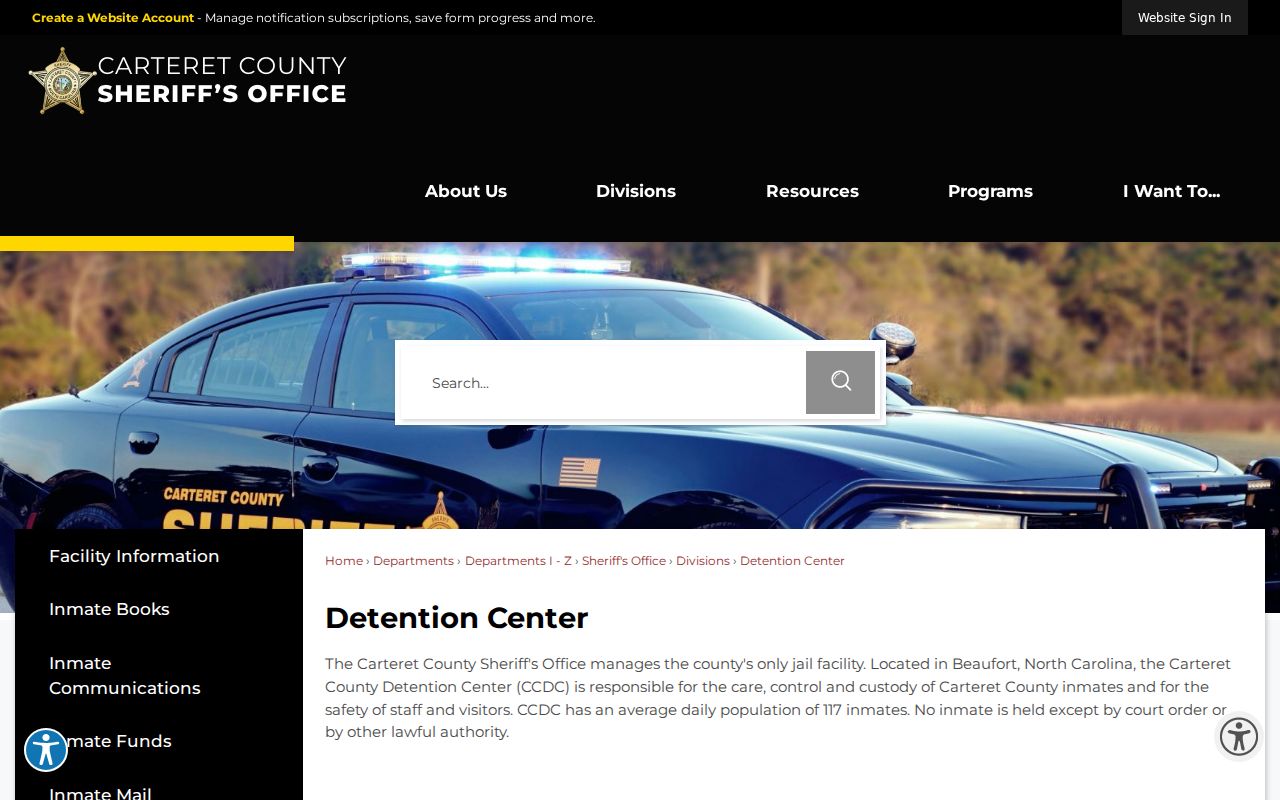
The image accompanies the county's own description of the jail, not a private booking gallery. Search the inquiry for present custody, then check the Carteret County arrest search routes for the arresting agency report and filed court case. Call (252) 504-4832 for inmate-data discrepancies. A blank search can mean release, transfer, spelling variation, processing delay, or that no Carteret jail booking occurred.
Record flow: Arresting agency › Carteret booking › court charge › SBI disposition update.
North Carolina Public Access Laws
North Carolina law starts with the custodian and then applies record-specific limits. Chapter 132 broadly treats government records as belonging to the people unless another law creates an exception. G.S. 132-1.4 keeps criminal investigative and intelligence files outside the ordinary public-record definition, yet subsection (c) makes core incident and arrest facts public. G.S. 7A-109 governs court-file inspection and copies. These rules do not expose Social Security numbers, protected victim and witness details, juvenile files, or sealed material.
Key statutes:
G.S. Chapter 132 provides inspection and copy rights, actual-cost rules, and the investigative-record distinction.
G.S. 7A-109 governs public access to court records subject to other law and court rules.
G.S. 15A Article 5 sets the categories, process, and effects of criminal-record expunction.
G.S. 14 Article 27A controls registry duties, access, and misuse.
Ask Morehead City, Beaufort, or Newport for a report created by that municipality. Ask the Sheriff for sheriff records, the clerk for a case, SBI for one's personal fingerprint history, and NCDAC for correction data. A precise request with date, location, incident number, agency, and desired format is easier to route and redact correctly.
Carteret Warrant Search Fallbacks
No comprehensive official Carteret active-warrant database was found in the research. The Carteret Sheriff NC app advertises Most Wanted, but that is a selected list. An empty app or Portal result cannot prove that no warrant or order for arrest exists. Search the related Carteret court events, ask the clerk at (252) 504-4400 about court process, and contact Sheriff Records or the main office at (252) 728-8400.
An order for arrest can follow a missed appearance or failure to comply. Search warrants, sealed indictments, juvenile process, and unserved process may remain nonpublic. A person checking their own possible process should ask the issuing court and legal counsel about appearance or surrender rather than assume that a counter visit guarantees release. After resolving the court matter, confirm that the clerk and law-enforcement systems both show the update.
Note: The Sheriff's app also offers inmate, registry, alert, tip, news, and local information tools, but each official source still has its own limits.
Restricted, Sealed & Expunged Records
North Carolina restricts juvenile records, protected identities, sensitive personal data, active investigative files, nonpublic repository history, and records covered by a valid expunction order. Expunction is a court process, not a request to remove a search result. A judge applies a specific statute, and the clerk sends the order to the agencies that must remove, seal, or destroy eligible material.
File a Carteret matter with the Carteret Clerk using the current statute-specific AOC petition and instructions. The general petition fee is $175. Dismissed or not-guilty matters often carry no fee unless dismissal followed diversion or deferred prosecution, while G.S. 15A-145.8A specifies $52.50 for its defined category. Eligibility can turn on offense law, age, date, prior record, sentence completion, restitution, waiting periods, and pending cases. Some relief under G.S. 15A-146 operates automatically, while other relief needs a petition and may require a hearing.
- Dismissal
- A charge ends without conviction, but the historical file does not always vanish without expunction.
- Disposition
- The outcome recorded for a charge or case.
- Expunction
- North Carolina's statutory process for removing and restricting eligible government records.
- Order for arrest
- Process directing an arrest, often tied to a missed appearance or noncompliance.
After an order, allow processing time and check both the clerk record and a new personal SBI review. If an agency still displays eligible material, provide the certified order and ask the Carteret Clerk whether notice was transmitted.
Carteret Custody and Supervision Records
County jail and state correction records are separate. Carteret Inmate Inquiry answers current local custody questions. Once a sentenced person enters state prison or NCDAC supervision, switch to NCDAC Public Offender Search. Court records still supply the judgment that imposed confinement or probation. VINELink provides custody-status notices, but it is not a full case docket or criminal history. The NCDAC Public Offender Search is the official state lookup entry point.
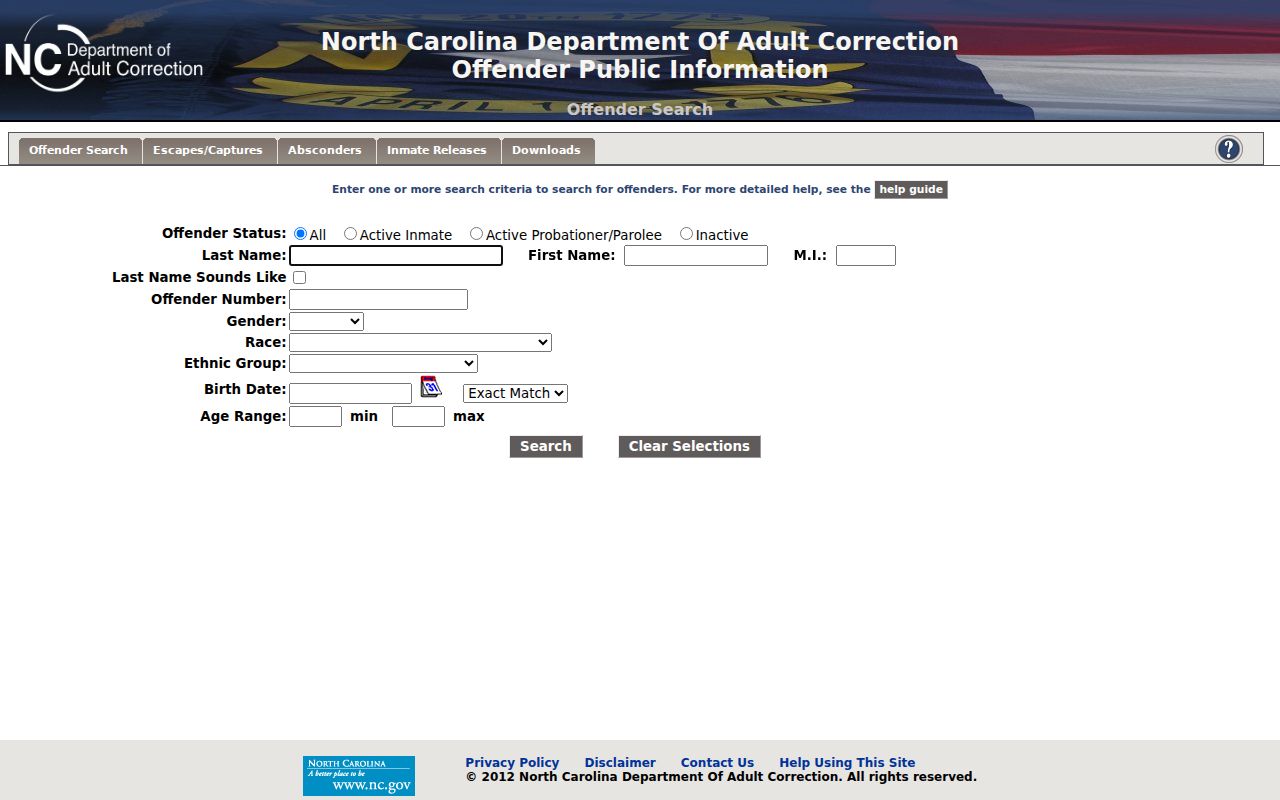
Its results concern state custody and supervision, so they should be read alongside the Carteret judgment when the exact offense or sentence matters. North Carolina supervision is state-run rather than a Carteret probation department.
The NCDAC Community Supervision overview explains probation, parole, and post-release supervision.
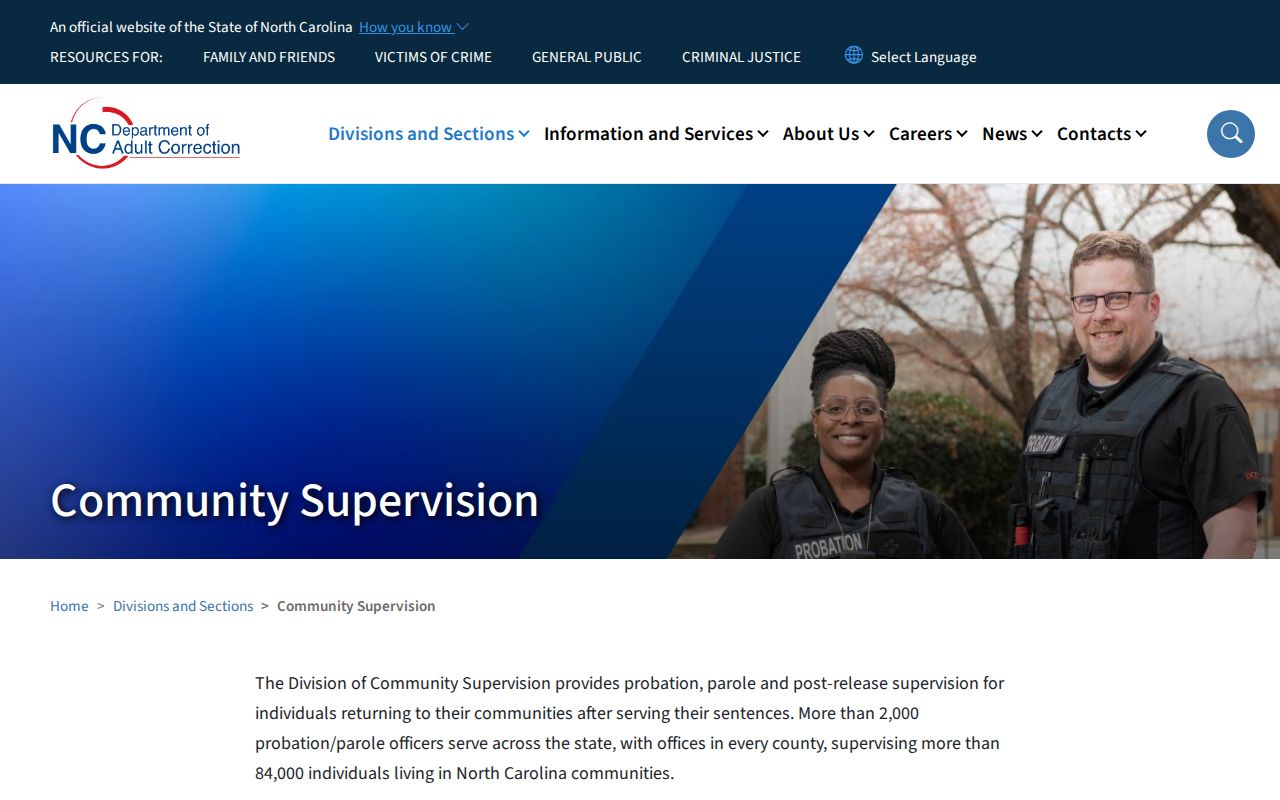
The two correction images represent different questions: one finds an offender record, while the other explains the agency that manages community supervision. Detailed officer files are not a public roster. A violation may lead to a report, court process, and hearing, and it does not always mean a new conviction.
City-by-City Criminal Records in Carteret County
Municipal police reports stay with the city that created them. Morehead City, Beaufort, and Newport arrests may lead to Carteret Detention Center booking and a state District or Superior Court file, but none of the three operates a separate municipal criminal court portal. Start with the police custodian for the report, use county inquiry for custody, and use Carteret court tools for the filed case.
Morehead City Record Check
The county's largest city routes police reports through its city channel and court matters through Carteret Clerk.
Beaufort Record Check
Town police, the county courthouse, and Sheriff Records are close by but remain separate custodians.
Newport Record Check
Newport's records manager and FAQ provide direct local report, court, and fingerprint routing.
City requests should never be sent to the county administrative form merely because the town lies in Carteret County. The form itself directs municipal requests back to the municipality.
Carteret Federal Criminal Record Layer
Carteret County lies in the U.S. District Court for the Eastern District of North Carolina. Federal criminal cases use PACER for docket and document access. Registration and federal usage fees can apply. A federal case will not necessarily appear as a Carteret state-court matter. Federal custody is searched through the Bureau of Prisons locator rather than Carteret Inmate Inquiry or NCDAC.
The official PACER service is the federal docket entry point.
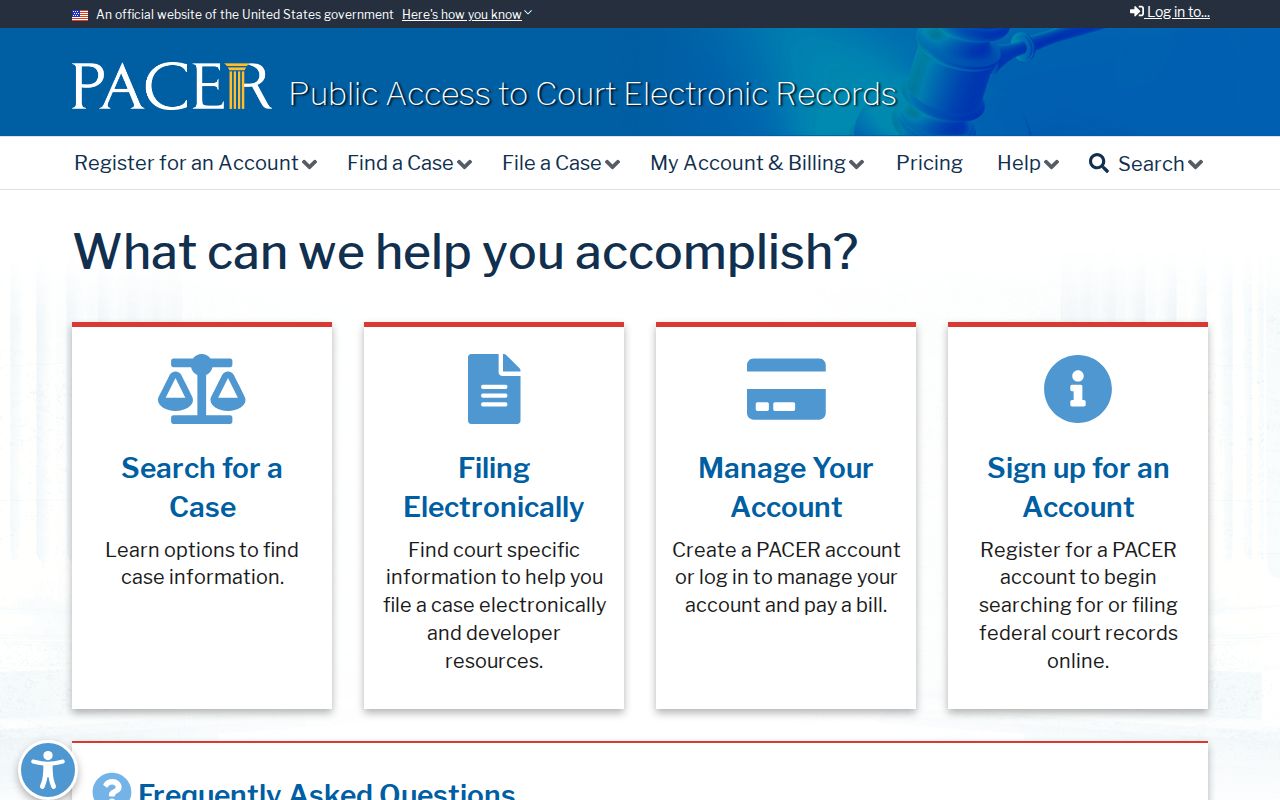
The PACER image marks a distinct federal layer, not a county search screen. The FBI electronic route provides a person's own national fingerprint summary, while the BOP locator concerns federal custody or release. None replaces the originating court file. The absence of county process also cannot rule out a sealed or federal warrant.